 704.228.7788
 704.228.7788
 07/01/2026
 17 minutes Read
The standing seam metal roof cost on a typical Davidson home in 2026 lands between $12 and $16 per square foot installed, which works out to $1,200 to $1,600 per square (every 100 square feet of roof). That’s where Roof Medic prices our standing seam systems, and it aligns with what 2026 industry data shows for steel and aluminum systems nationally. Standing seam isn’t a shingle upgrade. It’s a different roofing system entirely, and the homeowners who buy it usually aren’t shopping price. They’re shopping the last roof they’ll ever pay for.
Here’s what you’ll learn in this guide:
- Real 2026 pricing: What standing seam actually costs per square foot and per project.
- The 6 factors that drive the price: What pushes one quote higher than another.
- Whether it’s worth the investment: Where standing seam wins and where asphalt is the smarter call.
What a Standing Seam Metal Roof Actually Costs in 2026
Standing seam pricing depends on the material, the roof itself, and who’s installing it. Our pricing covers a professionally engineered system installed by a credentialed metal roofing team, not a corrugated panel job thrown together by a generalist. The two aren’t the same thing.
2026 Standing Seam Pricing per Square Foot
Roof Medic prices standing seam metal roof systems between $1,200 and $1,600 per square installed, which is $12 to $16 per square foot. That range covers the bulk of metal roofing projects we handle on residential homes in Davidson and surrounding areas. Premium metals like copper or zinc run significantly higher. Steel and aluminum cover most homeowners.
- Steel standing seam: $12 to $16 per square foot installed. Most common residential choice.
- Aluminum standing seam: $12 to $18 per square foot installed. Better for coastal corrosion resistance.
- Copper standing seam: $20 to $40 per square foot installed. Premium architectural option.
- Zinc standing seam: $20 to $35 per square foot installed. Long-lasting specialty material.
- Roof Medic standard range: $1,200 to $1,600 per square ($12 to $16 per square foot) for steel and aluminum systems.
Total Project Cost by Home Size
The per-square-foot number is useful for comparison. The total project cost is the actual check you’ll write. Here’s what to expect for typical home sizes in the Charlotte metro.
- 1,500 sq ft roof: Roughly $18,000 to $24,000 for a standing seam system.
- 2,000 sq ft roof: Roughly $24,000 to $32,000.
- 2,500 sq ft roof: Roughly $30,000 to $40,000.
- 3,000 sq ft roof: Roughly $36,000 to $48,000.
- Premium metal upgrades: Copper or zinc can push projects past $80,000 on a larger home.
Cost estimator
Standing Seam Metal Roof Cost by Roof Size
Move the slider to your roof size.
1,0004,000 sq ft
Architectural asphalt on the same roof: $8,000 to $22,000
Standing seam range High — $16/sq ft Low — $12/sq ft
How much does a standing seam metal roof cost?
Roof Medic prices standing seam metal roofs at $12 to $16 per square foot installed, or $1,200 to $1,600 per square (each 100 square feet of roof). On a typical 2,000 square foot roof in the Charlotte metro, that works out to $24,000 to $32,000. Steel and aluminum cover most homes; copper and zinc run $20 to $40 per square foot and can push a larger project past $80,000. Architectural asphalt, by comparison, runs $4 to $11 per square foot — roughly 2 to 3 times cheaper upfront, and roughly 2 to 3 times shorter-lived.
The lines are straight because standing seam is priced at a flat rate per square foot, so total cost scales directly with roof size. Final pricing still moves with pitch, complexity, tear-off, decking repairs, metal gauge, and paint system. This estimator is a planning tool, not a quote.
What Makes Standing Seam Different From Other Metal Roofs
Standing seam isn’t the only metal roofing system on the market. It’s the best one. The difference shows up in the seams, the fasteners, and how the system handles thermal movement.
How the System Works
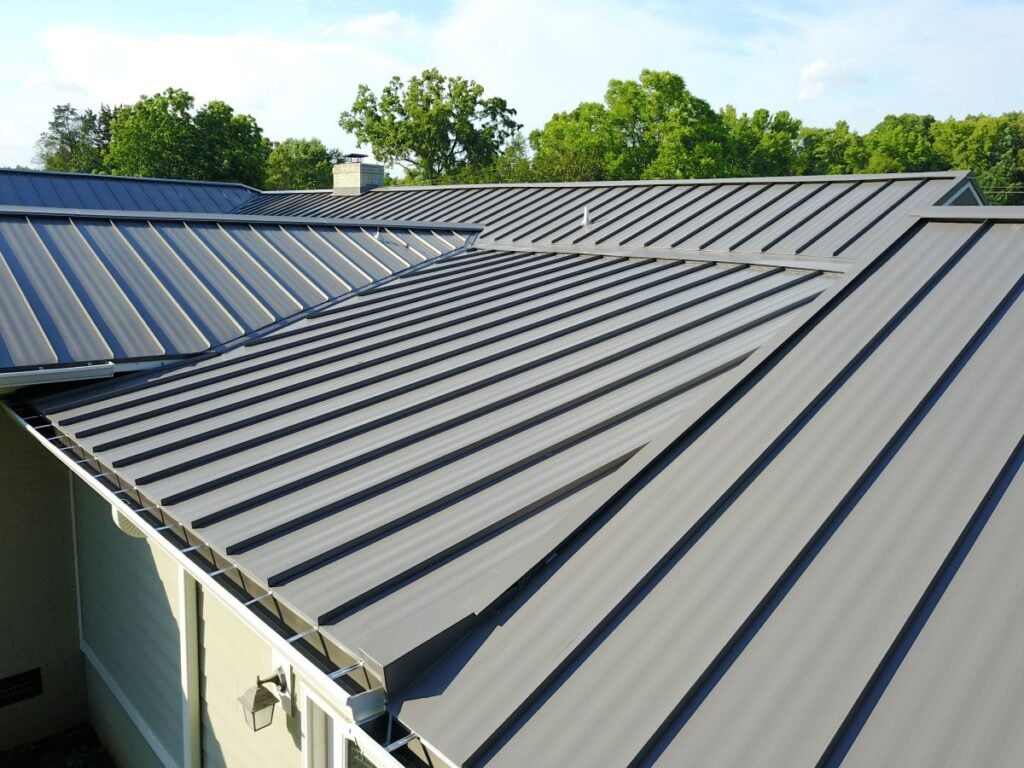
Standing seam metal roofs are characterized by raised vertical seams that run continuously from the roof ridge down to the eaves. The Insurance Institute for Business and Home Safety (IBHS) rates standing seam systems among the most weather-resistant residential roofing options available, with properly installed systems handling wind speeds of 140 mph or higher. The seams hide the fasteners completely, eliminating the most common leak path on cheaper metal systems. Panels run the full length of the roof slope, which means fewer joints and fewer places for water to get in.
- Vertical raised seams: Run continuously from ridge to eave with no horizontal joints.
- Hidden fasteners: No exposed screws or nails on the visible roof surface.
- Continuous panels: Each panel runs the full length of the slope.
- Thermal movement design: Panels float on clips, allowing expansion and contraction without damage.
- Sealed perimeter: Ridge caps, edge metal, and flashing complete the watertight system.
How Standing Seam Compares to Other Metal Options
Most homeowners shopping metal roofing don’t realize there are multiple metal systems at very different price points. The cheap corrugated panels you see on barns and outbuildings aren’t the same product. The difference matters in performance, lifespan, and how the roof looks on a residential home.
- Standing seam: Hidden fasteners, $12 to $16 per square foot, residential premium choice.
- Corrugated metal: Exposed fasteners, $7 to $12 per square foot, lower-end residential and agricultural.
- Metal shingles: Stamped panels mimicking asphalt or slate, $10 to $14 per square foot.
- Stone-coated steel: Steel panels with stone aggregate finish, $9 to $13 per square foot.
- Why we recommend standing seam: Cleanest aesthetic, longest lifespan, fewest leak points.
6 Factors That Drive Standing Seam Cost
Every standing seam quote moves around the same six factors. Knowing them helps you compare bids fairly and spot a contractor who’s lowballing the labor to win the job.
1. Metal Type and Gauge
The metal itself is the largest line item on most standing seam projects. Steel is the most common residential choice. Aluminum costs slightly more but handles corrosion better in humid climates. Panel gauge (thickness) matters too. Heavier gauges last longer and handle impact better, but cost more upfront. Most residential standing seam runs 24 or 26 gauge.
- 24-gauge steel: Premium thickness, longest lifespan, highest impact resistance.
- 26-gauge steel: Standard residential choice, good balance of cost and performance.
- 29-gauge steel: Lighter and cheaper, more common on outbuildings than homes.
- Aluminum: Naturally corrosion-resistant, lighter weight, slightly higher cost than steel.
- Premium metals: Copper and zinc add significant cost but deliver century-plus lifespans.
2. Paint System and Coating Quality
The paint system on a standing seam roof determines how it looks in 5, 10, and 30 years. Kynar 500 (PVDF) is the premium paint system and the one we install on standing seam projects. It resists fading, chalking, and chipping for decades. Cheaper polyester paint systems start to fade and chalk in under 10 years, which is why bargain metal roofs look bad faster than you’d expect.
- Kynar 500 (PVDF): Premium paint system with 30 to 40 year color warranty.
- SMP (silicone-modified polyester): Mid-tier option with 20 to 25 year warranty.
- Standard polyester: Lower-end option with 10 to 15 year warranty.
- Galvalume coating: Zinc-aluminum coating beneath the paint, extends corrosion resistance.
- Color choice: Reflective colors (whites, light grays) drop cooling bills.
3. Roof Size, Pitch, and Complexity
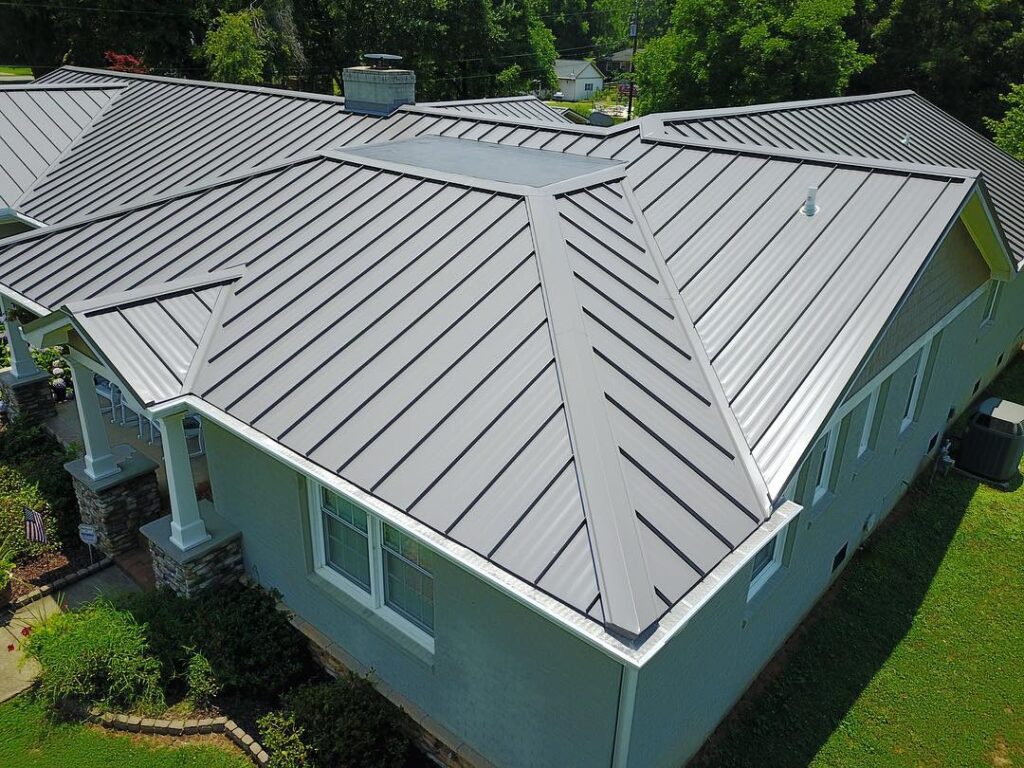
Bigger roofs cost more total but often less per square foot due to install efficiency. Steeper roofs cost more because of safety equipment and slower work. Complex roofs with multiple hips, valleys, dormers, and changes in pitch cost significantly more per square foot than simple gable designs. Every cut adds labor and material waste.
- Simple gable roofs: Cheapest per square foot to install standing seam.
- Hip roofs: Add more cuts and ridge work, raising the cost.
- Steep pitches: Slower work, more safety equipment, higher labor cost.
- Penetrations: Skylights, chimneys, and vents each add custom flashing work.
- Multi-plane roofs: Each change in direction adds complexity and material waste.
4. Tear-Off and Decking Repairs
Standing seam installs over a sound, clean deck. The existing roof comes off, the deck gets inspected, and any damaged sheathing gets replaced before the new system goes down. Tear-off adds $1 to $3 per square foot. Decking repairs run $70 to $150 per 4×8 sheet of OSB or plywood.
- Tear-off cost: $1 to $3 per square foot to remove existing shingles.
- Decking inspection: Required after tear-off, no extra cost.
- Decking replacement: $70 to $150 per 4×8 sheet when needed.
- Underlayment upgrade: High-temp synthetic underlayment required for metal roofs.
- Ice and water shield: Added at eaves, valleys, and penetrations per manufacturer spec.
5. Trim, Flashing, and Finishing Details
Standing seam is more than panels. Edge metal, ridge caps, valleys, gable trim, fascia, and chimney flashing all factor into the bid. The trim is often the same paint system as the panels, which adds material cost. Done right, the finished system looks intentional and architectural. Done cheap, it looks like an afterthought.
- Edge metal and drip edge: $5 to $15 per linear foot in matching paint.
- Ridge caps: Custom-fabricated to match panel color.
- Valley flashing: Open or closed valleys with metal-specific detailing.
- Gable trim: Color-matched trim along the rake edges.
- Penetration flashing: Custom boots and curbs for vents, chimneys, and skylights.
6. Contractor Credentials and Warranty
The contractor installing your standing seam system matters more than the metal you choose. Standing seam is unforgiving of bad installation. A poorly installed seam can leak in the first heavy rain. A poorly placed fastener can create thermal stress that buckles the panel within a year. We install standing seam systems with manufacturer-backed warranties, and our credentials qualify us for the higher-tier coverage available on the systems we install. Hire the wrong contractor and the warranty is worthless because it requires certified installation to honor.
- Manufacturer warranties: 30 to 50 year coverage on panels, 20 to 30 years on paint.
- Workmanship warranty: Roof Medic’s standard 2 years, 5 years on recommended approach.
- Certified installation: Required to qualify for the highest manufacturer warranty tiers.
- Installation experience: Standing seam is a specialty system, not a general roofing skill.
- Long-term accountability: Pick a contractor that’ll be around in 20 years.
Is Standing Seam Worth the Investment for Your Home?
Standing seam costs 2 to 3 times more than architectural asphalt at install. The question every homeowner asks is whether it’s worth the premium. Here’s how we actually answer that on inspections in Davidson and surrounding areas.
When Standing Seam Is the Right Call
The math on standing seam usually works in specific situations. Long-term ownership, high storm exposure, certain architectural styles, and energy-cost-conscious homeowners all see real returns on the investment.
- Long-term ownership: Plans to stay 25 plus years justify the higher upfront cost.
- Storm-prone areas: Standing seam handles wind and hail better than asphalt.
- Modern or farmhouse architecture: The visual fits the home style.
- Cooling cost concerns: Reflective metal can drop summer cooling bills.
- Solar plans: Standing seam is the preferred mounting surface for residential solar.
When Asphalt Makes More Sense
We don’t push standing seam on every customer. For some homes and some homeowners, asphalt is genuinely the better call. Honest contractors will tell you that. We will too.
- Short-term ownership: Plans to sell in under 10 years rarely recoup the premium.
- Tight budgets: A quality architectural asphalt roof outperforms a cheap metal install.
- Traditional architecture: Standing seam looks out of place on certain home styles.
- HOA restrictions: Some HOAs limit or prohibit metal roofing.
- Roof complexity: Highly complex roofs amplify standing seam’s cost premium.
How a Standing Seam Roof Compares to Shingles on Cost
The cost difference between metal and shingles is the conversation most homeowners want to have. The honest answer is that metal costs more upfront, lasts much longer, and ends up cheaper over a 50-year span. The catch is most homeowners don’t own a home for 50 years.
Upfront Cost Comparison
Architectural asphalt is the cheapest residential roofing option that performs well. Standing seam is one of the most expensive. The gap is real and worth understanding before signing a contract.
- Architectural asphalt: $4 to $11 per square foot installed.
- Standing seam metal: $12 to $16 per square foot installed.
- Cost ratio: Standing seam costs roughly 2 to 3 times more upfront than asphalt.
- Lifespan ratio: Standing seam lasts roughly 2 to 3 times longer than asphalt.
- Per-year cost: Roughly equal over the full lifespan of each system.
Long-Term Cost Comparison
The long-term math is where standing seam earns its premium. A homeowner who stays in the home for 50 years would replace an asphalt roof 2 to 3 times in that span. A standing seam installed on day one is still going strong at year 50.
- Replacement cycles: Asphalt requires 2 to 3 full replacements in 50 years. Standing seam requires zero.
- Insurance discounts: Many carriers offer discounts on impact-resistant metal roofs.
- Resale value: Standing seam homes typically sell faster and at higher prices.
- Energy savings: Reflective standing seam can drop cooling bills 10 to 20 percent.
- Maintenance: Standing seam needs less maintenance than asphalt over its lifespan.
Frequently Asked Questions
How long does a standing seam metal roof last?
A properly installed standing seam metal roof lasts 40 to 70 years in most North Carolina conditions. Steel and aluminum systems with quality Kynar 500 paint commonly hit 50 plus years. Copper and zinc roofs can last 100 years or more. Lifespan depends heavily on installation quality, paint system, and proper detailing at penetrations and seams.
Is a standing seam roof noisy in the rain?
Modern standing seam systems with proper underlayment and decking are no louder than asphalt shingles during rain or hail. The noise myth comes from old uninsulated metal roofs on outbuildings. A standing seam system installed over solid decking with synthetic underlayment sounds essentially the same as any other residential roof.
Will a standing seam roof lower my insurance premium?
Many homeowners insurance carriers offer discounts for impact-resistant metal roofs, especially in hail-prone areas. Discounts vary by carrier and policy but commonly range from 5 to 30 percent off the roof portion of the premium. Confirm eligibility with your insurance agent before installation.
Can I install a standing seam roof over my existing shingles?
Some standing seam systems can install over existing single-layer shingles where local code allows. However, we generally recommend full tear-off for warranty preservation and to allow proper inspection of the decking. The cost savings from skipping tear-off rarely outweigh the long-term performance benefits of a clean install.
How does standing seam handle hail?
Standing seam metal roofs are among the best-performing residential roofing options against hail. Smaller hail typically causes only cosmetic dimpling without compromising the watertight integrity. Larger hail can cause more significant damage, but most insurance claims on metal roofs involve cosmetic repairs rather than full replacements.
Does Roof Medic install metal roofs of all colors?
Yes. Standing seam panels are available in a wide range of metal roof colors, from traditional grays and bronzes to architectural blues, greens, and reds. We help homeowners select colors that complement their home’s exterior and fit any HOA restrictions.
Why Roof Medic Is the Right Team for Your Standing Seam Project
Roof Medic is a GAF Master Elite Contractor and a CertainTeed SELECT ShingleMaster with Wizard certification, which places us in the top 3% of roofers nationwide and qualifies us for the highest-tier manufacturer warranties available on the metal roofing systems we install. We inspect first and recommend second on every roof we evaluate. If standing seam is the right call for your home, we’ll quote it honestly at our standard $1,200 to $1,600 per square pricing and walk you through every line item. If you’d be better served by architectural asphalt, we’ll tell you that too. Our workmanship warranty is 2 years standard and 5 years when homeowners follow our recommended approach, all backed by a veteran-owned team that handles insurance claims start to finish and takes your home as seriously as you do.
Want guidance on a standing seam metal roof for your home or want to learn more about what a $1,200 to $1,600 per square investment actually covers? Contact us to learn more. We work with homeowners throughout Davidson and surrounding areas, and we’re happy to walk you through the materials, the warranty options, and the honest answer for your home.


