 704.228.7788

 704.228.7788

 12/24/2024
 11 minutes Read
Skylight installation cost in 2026 runs between $1,500 and $5,000 for a new skylight on a typical asphalt shingle roof, with most Charlotte-area homeowners landing in the $2,000 to $3,500 range for a standard fixed or vented unit. The price swings based on the type of skylight, your roof, and one factor most homeowners never see coming: your ceiling. A skylight isn’t just a window in your roof. It’s a roof penetration, which means the difference between a skylight that lasts decades and one that leaks comes down entirely to how it’s installed. This guide breaks down 2026 pricing by type and what actually drives the cost for homeowners in Matthews and surrounding areas.
Here’s what you’ll learn in this guide:
- Why installation quality matters most: How a proper install protects against leaks.
- 2026 pricing by skylight type: Real installed costs for fixed, vented, and tubular skylights.
- What drives the price: The factors that move your quote, including the ceiling surprise.
What Skylight Installation Costs in 2026

Skylight pricing depends first on the type of skylight and then on your roof and ceiling. Here’s the current lay of the land for a standard installation on an asphalt shingle roof in the Charlotte area.
2026 Skylight Cost Overview
Most homeowners installing a new skylight in 2026 pay between $1,500 and $5,000 depending on the type, size, and complexity. Replacing an existing skylight in a working opening costs less, typically $800 to $2,400, because the roof structure and flashing framework already exist. According to This Old House, skylight installation averages around $1,800 nationally, though your specific cost depends on features, materials, and roof conditions.
- Note on 2024 pricing: Costs have risen since 2024, partly because manufacturers now include more features standard.
- New skylight installation: $1,500 to $5,000 for a standard unit on an asphalt shingle roof.
- Skylight replacement: $800 to $2,400 in an existing working opening.
- Most common range: $2,000 to $3,500 for a standard fixed or vented unit.
- Labor rate: Typically $60 to $120 per hour for skylight installation.
4 Types of Skylights and Their Prices

The type of skylight you choose has the biggest impact on cost after installation complexity. The four types below cover nearly every residential skylight we install in Matthews and surrounding areas. Here’s what each one costs and where each one fits.
1. Fixed Skylights
Fixed skylights are sealed units that don’t open. They’re the most affordable traditional skylight and the most leak-resistant because they have no moving parts. Fixed skylights are ideal for living rooms, stairwells, hallways, and any space where you want natural light and a view of the sky but don’t need ventilation. Because there’s no motor, no crank, and no electrical connection, they’re the simplest to install and the least likely to develop problems over time.
- Installed cost: $1,500 to $4,000 depending on size and roof complexity.
- Best for: Living rooms, stairwells, hallways, spaces that need light not airflow.
- Leak resistance: Highest of the traditional skylight types, no moving parts.
- Glass options: Tempered, double-pane, and Low-E glass available.
- Lifespan: 20 to 30 years with quality glass and proper installation.
2. Vented (Fresh Air) Skylights
Vented skylights open to release heat and moisture, which makes them the best choice for kitchens and bathrooms. They come in three flavors: manual (opened with a hand crank or rod), electric (opened with a remote and wired to power), and solar-powered (opened with a remote, powered by a built-in solar panel, no wiring needed). The solar version is popular because it skips the electrician entirely and includes a rain sensor that closes the unit automatically at the first drop.
- Manual vented: $3,200 to $5,900 installed.
- Electric vented: $4,350 to $7,250 installed, plus $200 to $500 for an electrician if new wiring is needed.
- Solar-powered vented: $4,250 to $7,150 installed, no electrician required.
- Best for: Kitchens, bathrooms, and rooms that need heat and moisture release.
- Rain sensors: Electric and solar models close automatically when moisture is detected.
3. Tubular Skylights (Sun Tunnels)
Tubular skylights, also called sun tunnels, are compact units that channel daylight from a small dome on the roof through a reflective tube down to a ceiling diffuser. They’re the most affordable option because the roof penetration is small, no light shaft construction is required, and installation usually takes less than half a day. Sun tunnels are ideal for hallways, closets, bathrooms, and small rooms where a full skylight would be oversized or too expensive. As a Velux Certified Installer, we install Velux Sun Tunnels regularly on Charlotte-area homes.
- Installed cost: $500 to $1,500 depending on size and roof thickness.
- Best for: Hallways, closets, bathrooms, and small interior rooms.
- Fast installation: Often completed in under half a day.
- No light shaft: The reflective tube eliminates the need for framed shaft construction.
- Bright output: A 10-inch tube delivers surprising light to spaces standard windows can’t reach.
4. Custom and Specialty Skylights
Custom skylights are built to specific shapes, sizes, or architectural requirements, including pyramids, domes, oversized units, and multi-unit configurations. They cost the most because of specialized manufacturing, additional framing, and custom flashing. Custom skylights make sense for unique architectural designs or dramatic light features, but they require an experienced installer to seal properly.
- Installed cost: $1,000 to $10,000 or more depending on design and complexity.
- Best for: Unique architectural features and dramatic light designs.
- Custom flashing: Non-standard shapes require custom-fabricated flashing.
- Additional framing: Most custom units need extra structural framing.
- Installer experience: Complex shapes demand a proven skylight installer to prevent leaks.
4 Factors That Drive Skylight Installation Cost
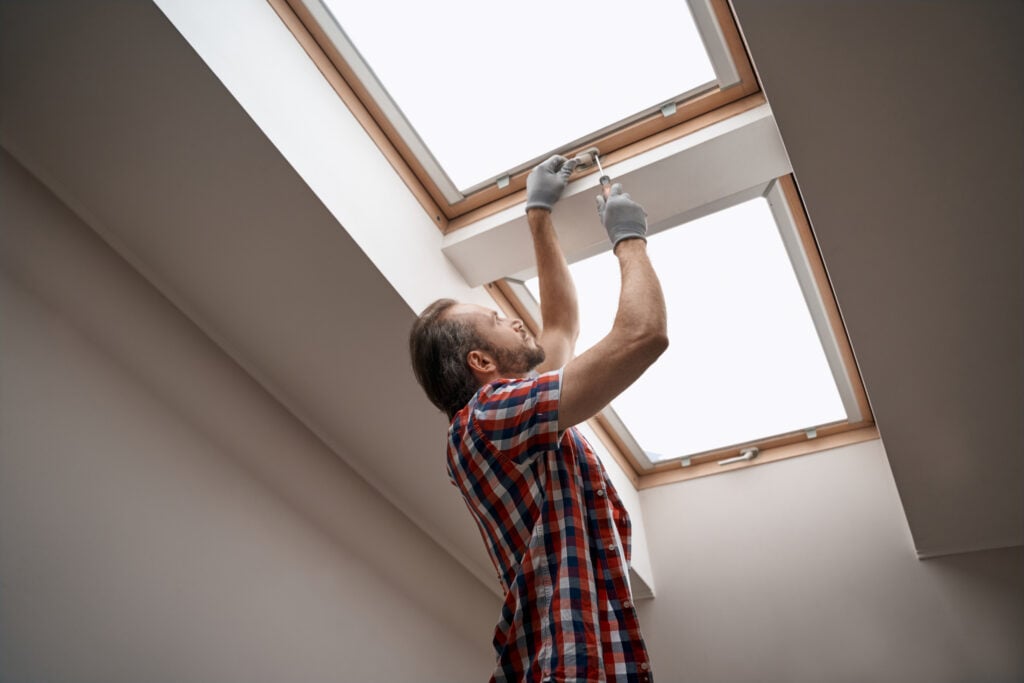
The type of skylight is just the starting point. Several other factors move the final number, and one of them surprises almost every homeowner. Here’s what we look at when quoting a skylight in Matthews and surrounding areas.
1. Your Ceiling Type (The Big Surprise)
This is the cost factor most homeowners never see coming. A skylight on a vaulted ceiling drops straight through the roof into the room, one surface, no tunnel. A skylight on a flat ceiling with an attic above requires building a framed light shaft from the roof opening down through the attic to the ceiling, then insulating, drywalling, taping, and painting every surface of that shaft. That shaft construction can add thousands to the project.
- Vaulted ceiling: Cheapest, the skylight drops straight through with no shaft.
- Flat ceiling with attic: Requires a framed light shaft, adding $2,600 to $5,700.
- Shaft finishing: Framing, insulation, drywall, and paint for the entire tunnel.
- Shaft angle: Angled or splayed shafts spread light better but cost more to build.
- Why it matters: Two identical skylights can cost thousands apart based on ceiling type alone.
2. Roof Material and Complexity
Your roof material affects how hard the skylight is to install and seal. Asphalt shingles are the easiest to cut and flash. Tile and metal cost more because of the specialized work involved. Roof pitch matters too, since steeper roofs require more safety equipment and slower work.
- Asphalt shingles: Easiest and cheapest to cut and flash.
- Tile roofs: Add up to 30% because tiles must be removed and reset without cracking.
- Metal roofs: Often require factory-matched curb kits and specialized sealer.
- Steep pitch: Requires more safety equipment and slower, more careful work.
- Roof obstructions: Wiring, ducts, and structural members in the way add labor.
3. Curb-Mounted vs Deck-Mounted
Skylights install one of two ways, and the method affects both cost and leak resistance. Deck-mounted skylights sit flush with the roof and are common on sloped asphalt roofs. Curb-mounted skylights sit elevated on a built-up frame, which is required on flat and low-slope roofs and often more leak-resistant.
- Deck-mounted: Flush with the roof, common on sloped asphalt roofs.
- Curb-mounted: Elevated on a frame, required on flat and low-slope roofs.
- Leak resistance: Curb-mounted designs often shed water better on low slopes.
- Flat roof requirement: Code requires curb-mounted units with at least 4 inches of rise on flat roofs.
- Cost difference: Curb-mounted costs more because the curb must be built first.
4. Permits and Weatherproofing
Cutting a new opening in a roof alters the structural envelope, which triggers code review and a permit in most jurisdictions. Proper weatherproofing is where a skylight succeeds or fails, and it’s not the place to cut corners.
Code compliance: New penetrations must meet current code, handled by your contractor.e project is completed to a high standard. Trustworthy professionals can save you the hassle of repairs later.
- Permits: Typically $100 to $500 for a new roof penetration.
- Replacement exemption: Replacing in kind may be exempt in some areas, verify first.
- Flashing kits: Manufacturer flashing kits are essential for a watertight seal.
- Weatherproofing: Quality sealing prevents the leaks that plague bad installs.
Is a Skylight Worth the Investment?
Absolutely! Though skylight installation requires upfront costs, the long-term benefits are hard to ignore:
- Natural Light: Brighten up dim rooms and reduce the need for artificial lighting.
- Energy Savings: Energy-efficient skylights can lower heating and cooling costs by improving ventilation and insulation.
- Home Value: Skylights enhance the aesthetic appeal and value of your property.
- Health Benefits: Exposure to natural light boosts mood and well-being.
For budget-conscious homeowners, starting with simpler options like tubular skylights or fixed skylights is an economical way to enjoy these perks.
Why the Installer Matters More Than the Skylight

Here’s the truth most cost guides skip. The skylight unit is only part of the equation. A skylight is a hole cut in your roof, and the flashing and seal around it determine whether it protects your home or becomes your next leak. In Charlotte’s climate, with heavy summer downpours and hurricane remnants pushing driving rain sideways, a poorly flashed skylight will find water. We’ve replaced plenty of skylights that leaked within a year because they were installed by someone who treated them as a window instead of a roof penetration.
What Proper Skylight Installation Requires
A skylight done right integrates with the roof system, not just the roof surface. The details below are what separate a skylight that lasts decades from one that leaks.
- Manufacturer flashing kits: Velux No Leak Skylights require Velux flashing for the warranty.
- Proper underlayment integration: The skylight ties into the roof’s water barrier.
- Correct step flashing: Flashing layered properly with the surrounding shingles.
- Ice and water shield: Added around the penetration for extra leak protection.
- Attic obstruction check: Wiring, ducts, and framing checked before the first cut.
The Velux No Leak Warranty Advantage
Velux is the largest skylight manufacturer in the country, and their No Leak Skylight warranty covers the skylight, the flashing, and the installation for 10 years when installed with Velux flashing by a qualified installer. As a Velux Certified Installer, Roof Medic installs to that standard, which keeps the warranty intact and gives homeowners real protection against the leaks that skylights are notorious for.
- 10-year coverage: Covers skylight, flashing, and installation defects.
- Flashing requirement: Warranty requires installation with Velux flashing.
- Certified installation: Velux Certified Installers are trained on the flashing system.
- Leak protection: The warranty directly addresses the most common skylight failure.
- Roof Medic credential: We’re a Velux Certified Installer, qualified for the full warranty.
A Note on Skylight Tax Credits in 2026
The original version of this article suggested claiming energy rebates on skylights. That guidance has changed. As of early 2026, Velux has stated it can no longer certify that solar-powered skylights qualify for the federal Residential Clean Energy Credit under Section 25D, and the credit itself expired for property placed in service after December 31, 2025. If you’re considering a skylight partly for a tax credit, consult a tax professional before purchase rather than assuming the credit is available.
- Section 25D status: Expired for property placed in service after December 31, 2025.
- Velux position: No longer certifies solar skylights qualify as of early 2026.
- Consult a professional: Talk to a tax advisor before assuming any credit applies.
- Energy savings still real: Skylights can still cut daytime lighting costs $50 to $150 per year.
- Vented cooling benefit: Vented skylights release hot air, reducing summer cooling load.
How to Get the Right Skylight for Your Home
A skylight is one of the best ways to bring natural light into a dark room, but the value depends entirely on choosing the right type for your space and installing it so it never leaks. The biggest cost surprises come from ceiling type and installation complexity, and the biggest long-term risk comes from poor flashing. That’s why the right move is a hands-on evaluation from a contractor who installs skylights as roofing projects, not afterthoughts. As a Velux Certified Installer, a GAF Master Elite Contractor, and a CertainTeed SELECT ShingleMaster in the top 3% of roofers nationwide, Roof Medic installs skylights that are sealed to last and backed by the Velux No Leak warranty. We inspect first and recommend second on every project, walking you through the right type, the real cost, and what your ceiling and roof actually require. Contact Roof Medic today for guidance on your skylight project. We work with homeowners throughout Matthews and surrounding areas and we’re happy to walk you through your options.

